
Who Knew They Could Weigh In?
By Equipo de PReporta · October 13, 2026
Decisions that affect our communities
A safe sidewalk, an accessible bus stop, or a crosswalk can change how people get around their community. But who decides which projects come first—and how can the people affected by those decisions have a say?
The draft 2027–2030 Statewide Transportation Improvement Program (STIP) outlines proposed investments in roads, public transportation, and other mobility needs. The Transportation Improvement Program (TIP) identifies proposed projects in metropolitan areas. The STIP brings those programs together with proposed investments in other parts of Puerto Rico.
The draft includes funding for sidewalks along PR-21, a Complete Streets study in Cayey, and buses for the Puerto Rico Metropolitan Bus Authority. A project’s inclusion in the program does not mean it is new or that construction is guaranteed to begin right away.
That’s why it matters to know how these priorities were set—and who had an opportunity to weigh in.
A public notice and 15 days to comment
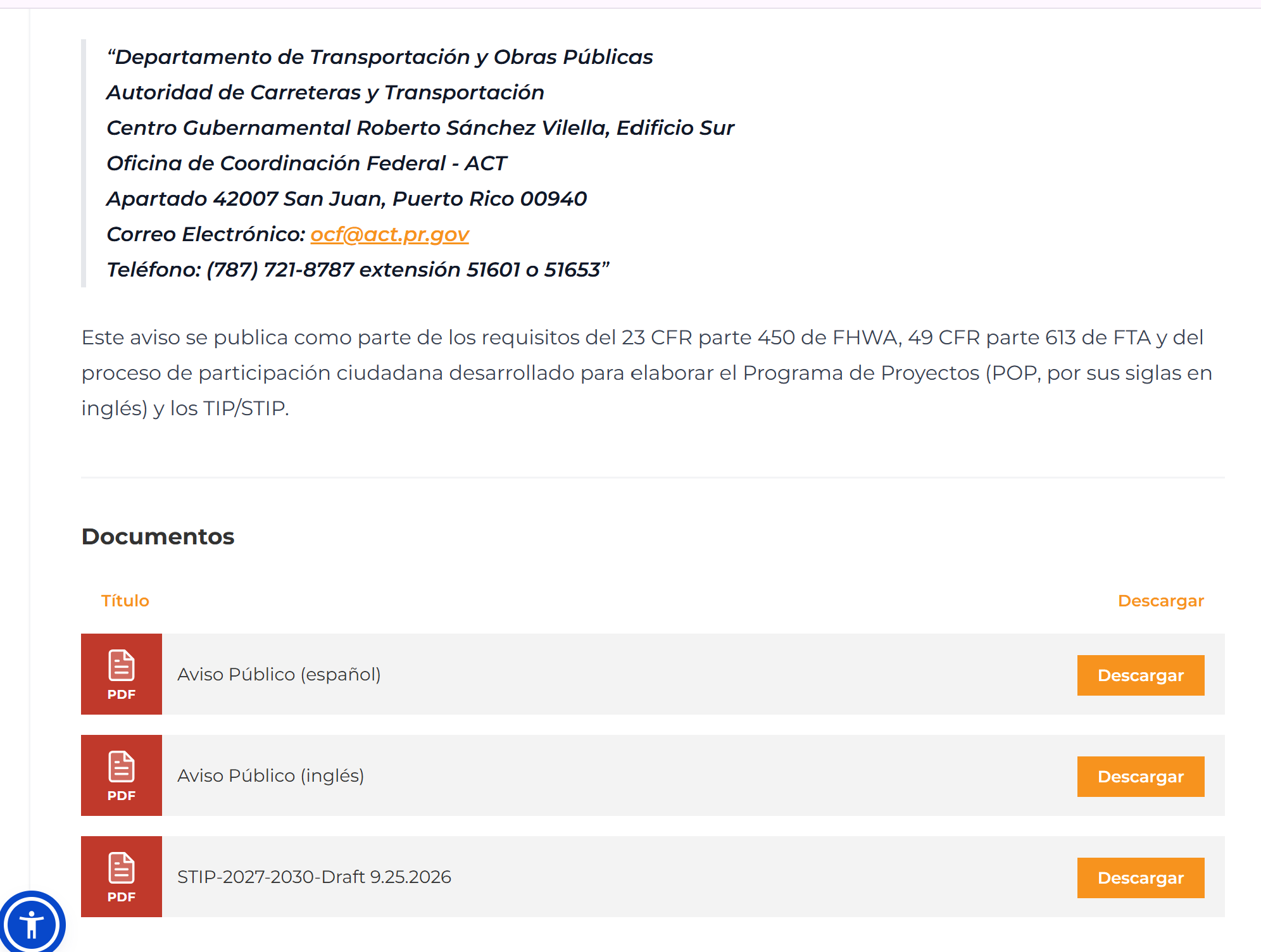
The Puerto Rico Metropolitan Planning Organization (PRMPO) approved the 2027–2030 metropolitan programs on August 27, 2026. On September 25, the Department of Transportation and Public Works (DTOP) and the Highway and Transportation Authority (ACT) posted a notice about the draft STIP and gave the public 15 calendar days to submit comments. The notice was available in Spanish and English.
The 178-page draft we reviewed is in English. We did not find an equivalent Spanish version on the notice page. That alone does not establish a violation of federal law, but it raises an important question: What options did Spanish-speaking residents have to understand and comment on the proposed investments?
The public notice documents an opportunity to comment on the statewide draft. By itself, it does not explain how communities were invited to participate before the metropolitan programs were approved.
Who participated—and how can we tell?
The draft STIP says the PRMPO provides opportunities for public participation and receives proposals from municipalities, government agencies, and members of the public. But the section we reviewed does not identify meetings held for the 2027–2030 cycle, participating organizations, or comments received.
That does not prove these activities never took place. It means that, based on the documents reviewed so far, we cannot determine who participated or how their input was considered.
Did community organizations, people with disabilities, older adults, public transit riders, and residents of rural communities take part? What recommendations did they make? Which ones were incorporated?
Other MPOs publish records that help answer questions like these. El Paso, Texas, for example, announced public meetings and several ways to comment on its 2027–2030 program, with information available in English and Spanish. It offers a useful example of public outreach, though those meetings were part of El Paso’s metropolitan program process. To make a fair comparison, we still need to learn what opportunities were offered during the preparation of Puerto Rico’s TIPs and STIPs.
What do the rules require?
Federal transportation planning regulations call for public participation, access to information, and consideration of public comments. The ACT’s 2021 Public Participation Plan for non-urbanized areas also describes regional meetings, public notices, and responses to significant comments.
Federal regulations do not set one uniform 30- or 45-day comment period for every draft STIP. So we cannot say that Puerto Rico’s 15-day period automatically violated the law. We can ask whether the notice and other outreach methods gave people a reasonable opportunity to participate—particularly when the draft is 178 pages long and available in English.
We also need to find out which participation plan is in effect in 2026, whether it has been updated, and where the records for the 2027–2030 process can be found.
Public participation should be verifiable
Posting a notice is one part of the process. It also matters how communities were reached, who could understand the information, and what happened to the comments people submitted.
The public should be able to find answers: What meetings took place? Which communities and groups were represented? How many proposals were received? How were they considered? The question is not only whether an opportunity was announced, but whether communities could take part and make their voices heard.
Did you know you could weigh in?
Did your municipality, a government agency, or a community organization invite you to participate in preparing the 2027–2030 transportation programs? Did you see a notice, attend a meeting, or submit a recommendation?
We want to hear about your experience.
Puerto Rico Reporta will continue reviewing notices, meeting records, participation records, and comments related to this process.
About this investigation
Puerto Rico Reporta investigates public participation in transportation planning and investment decisions in Puerto Rico. This article draws on official documents, federal regulations, and practices used by other metropolitan planning organizations. The fact that a document was not among the sources we reviewed does not necessarily mean the related activity did not take place. We will continue examining the 2027–2030 process and reporting what we can verify.
Sources: ACT public notice; draft 2027–2030 STIP; ACT Public Participation Plan (2021); 23 CFR § 450.210, § 450.316, and § 450.218; El Paso MPO public participation page.
Comments
You need an account to comment. We ask for this to keep the conversation spam-free.
Log in or sign upLoading comments…